In the mid-2000s, if you were on the internet and under twenty, you were probably on Newgrounds, Miniclip, or Armor Games. These sites hosted thousands of small browser games built in Adobe Flash — games you could play in Internet Explorer without downloading anything, games that your parents didn't know were there, games built by single developers in their bedrooms who released them for free because that was what you did.
That era is over. Flash was killed in December 2020. But understanding what happened — and what came after — explains a lot about how browser gaming works today.
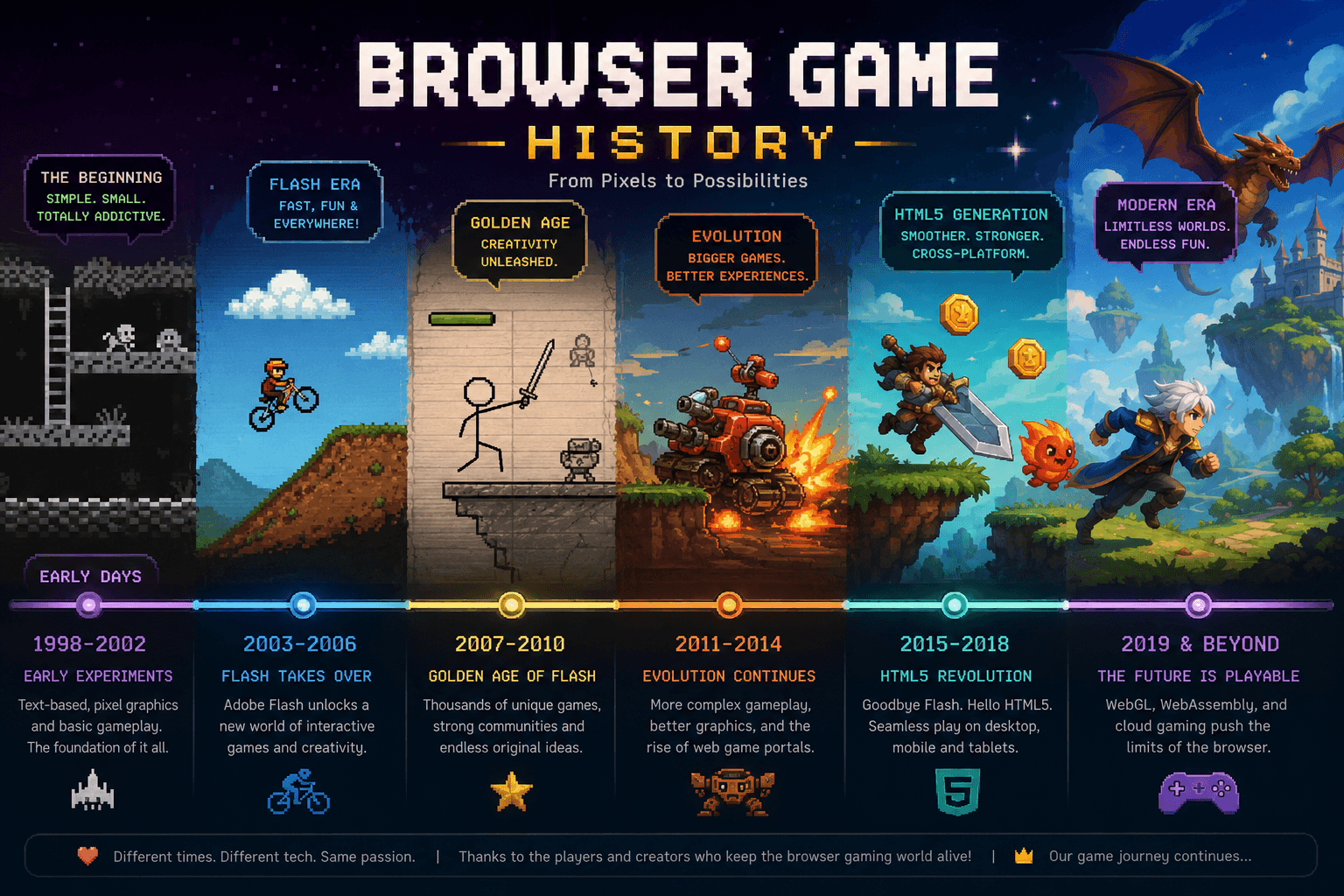
The Flash Era (1996–2017)
Adobe Flash was a platform for animated multimedia content. It wasn't designed specifically for games, but it was capable enough and browsers supported it natively, which made it the natural choice for anyone who wanted to make something interactive for the web.
The early Flash games were genuinely primitive. Stick figure animations with click-to-attack mechanics. Simple platformers with no save states. Quiz games. But as developers got better with the platform and computers got faster, the complexity grew. By the late 2000s, Flash games included full RPGs, tower defense games with dozens of levels, physics puzzles, and multiplayer games connecting players through the browser.
Newgrounds was the center of this ecosystem. Founded by Tom Fulp in 1995, it started as a site for Flash animations and became the largest repository of user-created Flash content on the internet. Games on Newgrounds ranged from creative experiments to full titles that would have been sold commercially in an earlier era. The community was unfiltered, sometimes crude, and genuinely creative in ways that more polished platforms weren't.
Miniclip and Armor Games took a more curated approach, hosting Flash games with a wider audience in mind. These were the sites that ended up on school computers because they looked relatively safe. Stick RPG, Bloons Tower Defense, and Run all found their mainstream audiences here.
The Problem With Flash
Flash worked through a browser plugin — a separate piece of software that browsers loaded to run Flash content. This architecture had security holes. Flash vulnerabilities were regularly discovered and exploited to install malware, and because Flash was everywhere, those vulnerabilities were high-value targets.
Apple's decision not to support Flash on the iPhone in 2010 was the turning point. Steve Jobs published an open letter explaining the decision, and while it was controversial, it started shifting developer attention toward HTML5 and JavaScript as alternatives. If you wanted your content to work on mobile — and by 2010, you did — Flash wasn't the path.
Adobe announced in 2017 that they would end Flash support in 2020. Browsers had already been disabling Flash by default for years. When December 31, 2020 arrived, Adobe's Flash Player stopped working, and everything that depended on it stopped too.
What Was Lost
Hundreds of thousands of Flash games became unplayable overnight. Some of them were bad. Many of them were mediocre. A meaningful number were genuinely excellent and had no successors.
The Flashpoint project, started in 2018, worked to preserve these games before they disappeared. The team has archived over 100,000 Flash titles along with other web-based content. The archive is downloadable, which isn't the same as playing in a browser, but it's the reason these games still exist at all.
Beyond the games themselves, what was lost was a particular kind of creative culture — individual developers releasing work without commercial pressure, building weird things because the tools were available and the audience was there. Flash lowered the barrier enough that people who weren't professional developers could ship a game and have people play it.
HTML5 Gaming Takes Over
HTML5 and JavaScript had been developing as Flash alternatives for years before Flash died. By 2020, they were mature enough that the transition, while abrupt, wasn't catastrophic. Most of what Flash could do, HTML5 could do — and in some ways better, particularly on mobile and for performance.
The .io game boom (Agar.io launched in 2015) happened entirely in the HTML5 era. These games demonstrated that browser-based multiplayer gaming was possible at scale. Thousands of players in the same game instance, running in a browser tab, with no plugins required.
Platforms like itch.io became the spiritual successor to Newgrounds for indie developers, though the culture shifted more toward downloadable games than browser-based ones. The browser game ecosystem today is smaller in terms of sheer creative variety than the Flash era, but more technically capable and more accessible across devices.
Where Browser Gaming Is Now
The current browser gaming landscape is split between .io-style multiplayer games, HTML5 adaptations of mobile games, and a smaller scene of independent developers making browser-based titles through game jams and itch.io.
The major studios largely moved away from browsers toward apps and downloads. The indie scene kept browser gaming alive, though it looks different from what it was. The Wordle phenomenon — a single developer's browser-based game that became a global daily ritual — showed that browser games can still break through to mainstream audiences.
Flash is gone. The games it made possible mostly aren't. The culture that grew up around them shaped a generation's relationship with gaming in ways that are hard to overstate. And the browser, stripped of its plugin dependency, is a better platform now than it was then — just different.