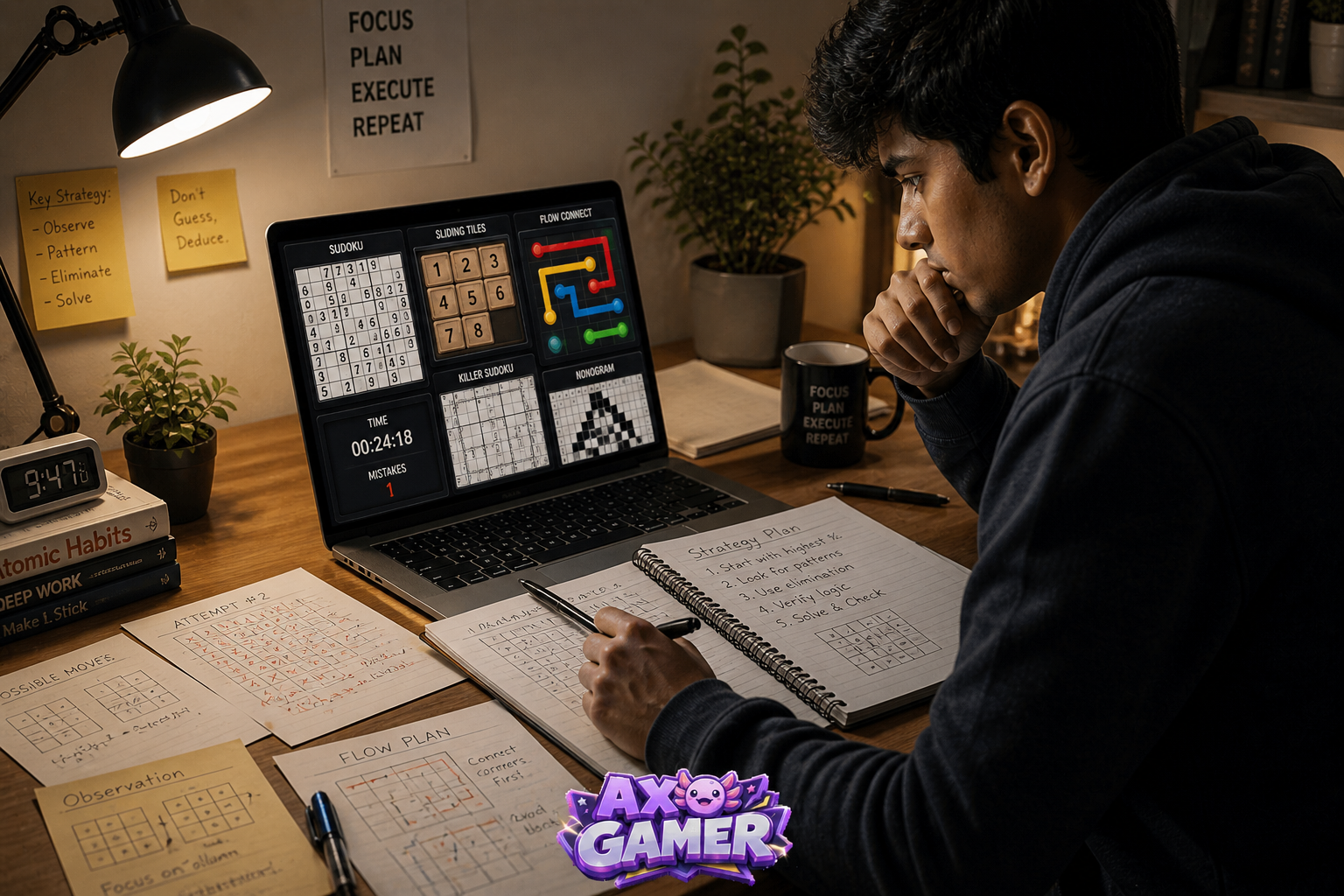
Why Puzzle Games Feel Impossible Sometimes
There's a specific kind of frustration that comes from staring at a puzzle you can't solve. You can see all the pieces. You know what the goal is. But the solution just... won't come. If that sounds familiar, you're not alone — and more importantly, it's not a sign that you're bad at puzzle games. It's a sign that you're using the wrong approach.
Here are seven things that actually work.
Tip 1: Stop Rushing
The biggest mistake puzzle game beginners make is trying to solve everything as fast as possible. Speed is the enemy of good puzzle-solving. The best puzzle players spend most of their time observing and planning, and very little time actually making moves. Before you touch anything, take 10–15 seconds to look at the whole board. What do you know for certain? What are you unsure about? Start from what you know.
Tip 2: Work Backwards from the Goal
Instead of asking "what should I do first?", ask "what does the solved state look like, and what must be true immediately before that?" Working backwards reveals constraints you wouldn't notice moving forwards. This technique is especially effective in games like Ice Slide Puzzle and Color Path Builder where the end state is clearly defined.
Tip 3: Use Process of Elimination
If you're not sure what the right move is, figure out what moves are definitely wrong and eliminate them. This is exactly how Sudoku is supposed to be played — not by guessing where numbers go, but by proving where they can't go until only one option remains. Apply this thinking to any puzzle and you'll be surprised how often it clarifies the solution.
Tip 4: Take Breaks When You're Stuck
This one is counterintuitive but scientifically supported. When you're stuck on a puzzle, continuing to stare at it activates cognitive fixation — your brain gets locked into one way of seeing the problem and can't shift perspective. A 5-minute break lets your mind reset. You'll come back and often see the solution immediately. It's not giving up — it's smart strategy.
Tip 5: Play More Games, Not Just One
The more different types of puzzles you play, the better your general puzzle-solving instincts become. Playing only Sudoku makes you better at Sudoku. But playing Sudoku, Sliding Puzzle, Word Connect, and Color Path Builder cross-trains your brain to recognize different types of patterns and constraints. Variety is the fastest path to improvement.
Tip 6: Understand the Rules Deeply Before You Start
Most failed puzzle attempts happen because the player didn't fully understand a rule. Before you start a new puzzle game, spend time with the tutorial or instructions — even if you think you get it. Pay special attention to edge cases and exceptions. Knowing the rules deeply means you can spot solutions that other players miss.
Tip 7: Embrace Failure as Data
Every wrong move tells you something. If your approach didn't work, you've eliminated one possibility. Many players get demoralized by failure in puzzle games when they should actually be encouraged — each failed attempt is genuine progress. The best puzzle players treat every mistake as useful information, not as evidence that they can't solve it.
Where to Practice Right Now
The best way to apply these tips is to actually play. AxoGamers has over 30 free puzzle games available instantly in your browser — no download, no account. Start with Sudoku Ultimate if you like numbers, Sliding Puzzle if you want spatial challenges, or Word Connect Master if you're more of a language person. Pick one, apply these tips, and watch your performance improve in real time.