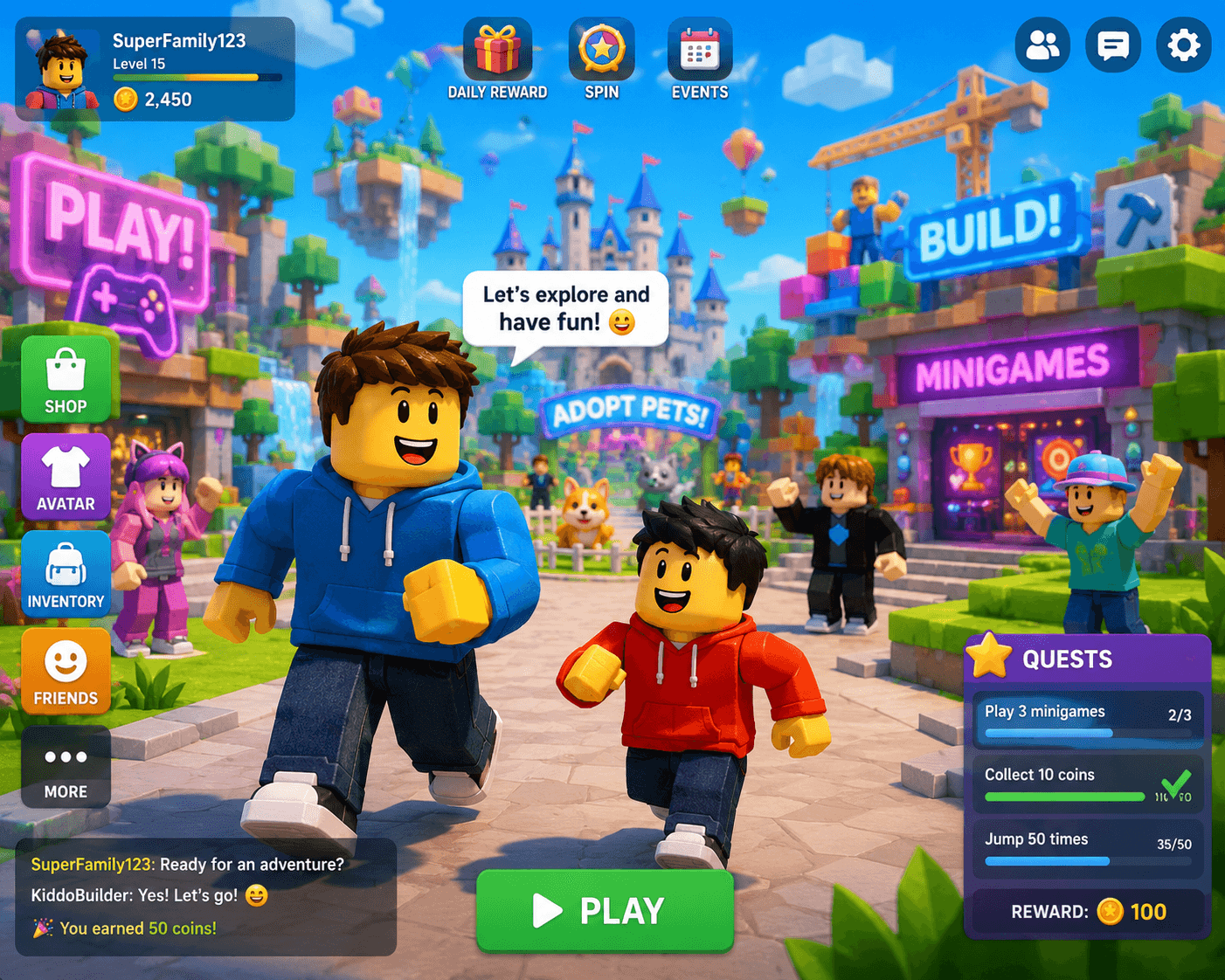
Roblox is one of the most popular platforms among children aged 6-16, with hundreds of millions of registered accounts. If your child is asking to play it and you're not sure what it is, this guide covers the key information without either dismissing the concerns or overstating them.
What Roblox Actually Is
Roblox is not a single game. It's a platform where users (mostly independent developers, many of them teenagers and young adults) create games that other users can play. Your child might play a Roblox game that simulates running a restaurant, a game that's essentially a tycoon builder, an obstacle course game (called "obbies"), a roleplay game, or a combat game — all within the same app under the Roblox umbrella.
The quality and content of these games varies enormously because anyone can publish. Some are well-made and appropriate for young children. Some are designed for older players and contain mature themes. Some are poorly designed and boring. The variety is the key thing to understand: "Roblox" doesn't have a single content rating any more than "the internet" does.
The Real Risks
Chat and communication: Most Roblox games have chat features. Players can communicate with your child in-game. Roblox has chat filters that block specific words and phrases, but filters are imperfect and the volume of communication happening across the platform makes moderation difficult. The chat risk is real and worth taking seriously.
In-app purchases: Roblox uses a virtual currency called Robux. Many games within Roblox push players to spend Robux on in-game items. The currency abstraction (Robux rather than dollars) makes spending feel less real. Children who have access to payment methods attached to their account can spend money without fully understanding the cost. This is easily managed by not attaching payment methods to children's accounts and using gift cards for any intended purchases.
Age-inappropriate content: Because anyone can create games, some games contain content that isn't appropriate for young children — violence, adult themes presented indirectly, or roleplay communities that engage in mature content. Roblox removes games that violate its terms of service, but new ones appear regularly.
Social pressure and gaming habits: Friends play Roblox, which creates pressure to play and keep up with in-game items. This is more of a normal social dynamic than a platform-specific risk, but it's worth being aware of when monitoring screen time.
What Roblox Does Right
Roblox has parental controls that are actually useful. You can restrict chat to only approved contacts or disable it entirely. You can require parental permission before any purchase. You can set what content categories are accessible based on age settings. You can monitor your child's activity.
The platform also has a reporting system for inappropriate content and a moderation team, though response times vary. Roblox has invested more in safety infrastructure than many comparable platforms.
Practical Steps for Parents
Create the account yourself and set the birth year accurately — Roblox adjusts content access and chat restrictions based on age. Enable all parental controls through the Roblox parent dashboard. Do not attach payment methods directly to the account; use Robux gift cards for intended purchases instead. Ask your child to show you what games they're playing — spend fifteen minutes watching them play. Know who they're chatting with in-game.
The biggest risk mitigation is active involvement. Children who know their parents are aware of their gaming activity, who can't play on demand without oversight, and who feel comfortable talking about what happens in games are much safer than children for whom gaming is an entirely private, unmonitored activity.
Is It Worth the Concern?
Roblox has real risks that are worth addressing. It also has real value — creative games, social connection, and for some children, early exposure to game design through Roblox Studio. The platform isn't uniquely dangerous, but it's also not a children's toy in the way that fully curated platforms are.
With active parental involvement and appropriate controls, it can be a fine experience. Without those things, it's an unsupervised social platform with uneven content moderation — which is a different situation entirely.