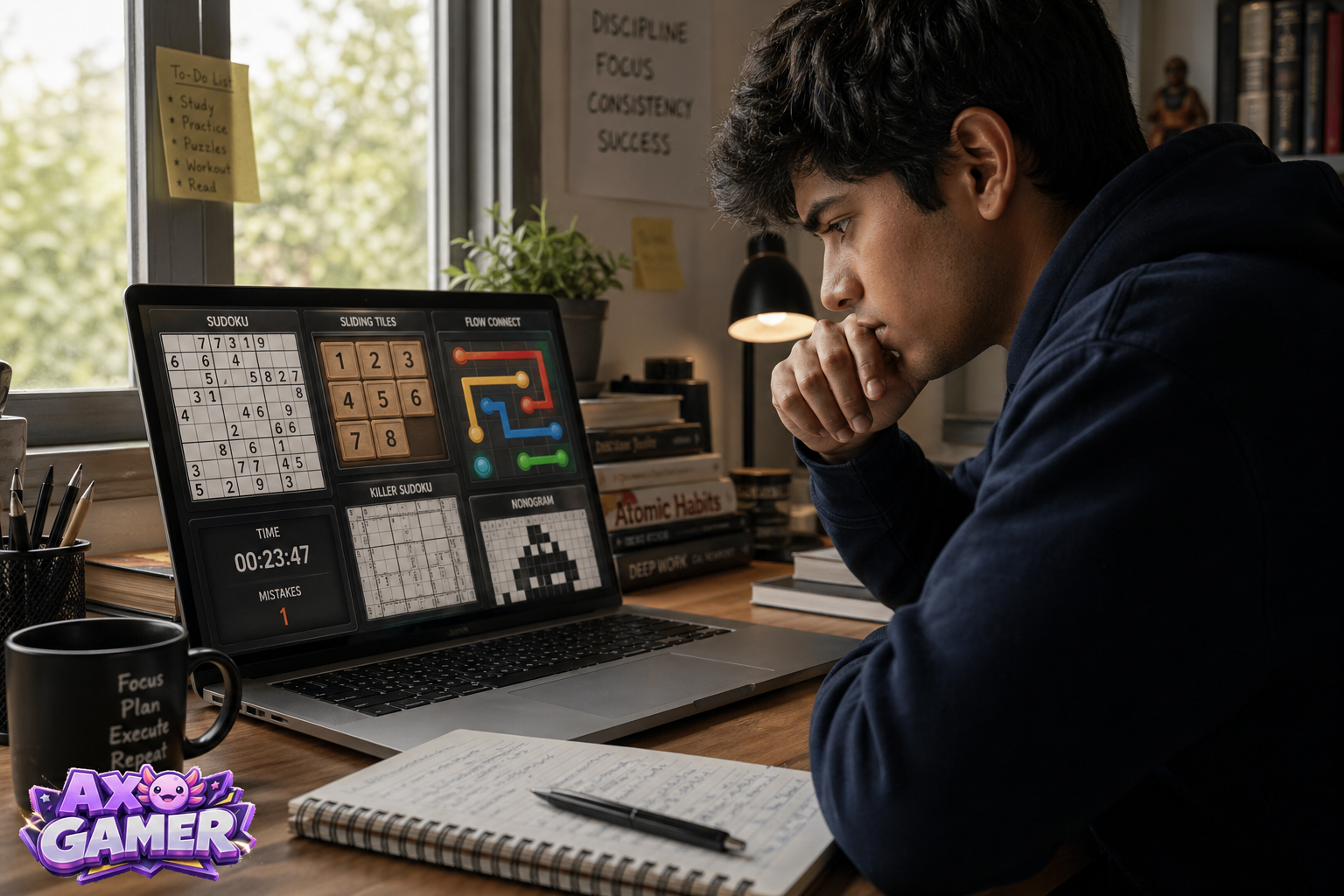
Gaming That Actually Does Something for Your Brain
There's a reason your grandparents do crosswords and Sudoku every morning. Puzzle games keep your brain sharp. Multiple studies from Cambridge and Harvard have found that regular puzzle-solving improves working memory, attention to detail, and pattern recognition. And the best part? You don't need an expensive app subscription. These ten free browser games will give your brain a proper workout, completely free.
The Top 10 Brain-Boosting Puzzle Games on AxoGamers
1. Sudoku Ultimate
The gold standard of number puzzles. Sudoku Ultimate on AxoGamers comes with multiple difficulty levels, clean visuals, and a hint system for when you're truly stuck. What makes Sudoku special isn't just the numbers — it's the way it forces you to think in patterns and eliminate possibilities. Spend 15 minutes on this daily and you'll genuinely notice an improvement in your logical thinking over time.
2. Color Path Builder
This game sneaks up on you. What looks like a simple connect-the-dots exercise quickly becomes a sophisticated spatial reasoning challenge. You need to plan several moves ahead, visualize how paths will interact, and sometimes sacrifice the obvious move for a better long-term strategy. It's chess disguised as a coloring game — and it's brilliant.
3. Smart Home Puzzle
A unique puzzle that places you in control of a smart home system. You need to solve circuit-style puzzles to get appliances working in the right order. It trains your sequential thinking and teaches basic logic gate concepts without you even realizing it. Surprisingly deep for something that looks so approachable on the surface.
4. Sliding Puzzle
The classic tile-sliding puzzle gets a fresh coat of paint here. Rearrange the scrambled tiles to complete the picture. It sounds straightforward until you realize that every move affects everything else on the board. This game is pure spatial reasoning — and getting good at it will genuinely improve how you visualize and plan in real life.
5. Word Connect Master
Find hidden words in a jumble of letters. Simple concept, surprisingly deep execution. Word Connect Master grows your vocabulary, improves your spelling, and trains your brain to recognize patterns in language. The levels start easy and get progressively harder, so there's always a new challenge waiting. Great for language learners too.
6. Time Travel Puzzle
This one bends your brain in interesting ways. You manipulate time-based mechanics to solve puzzles — think of it as a cause-and-effect simulator. Every action you take has ripple effects across different time states. It demands planning, foresight, and creative thinking. Not easy, but incredibly satisfying when it clicks.
7. Quantum Cube Solver
Inspired by Rubik's cube mechanics, Quantum Cube Solver challenges you to think in three dimensions. Rotate faces, align colors, solve the configuration. It trains spatial visualization — the same cognitive skill used by architects, engineers, and surgeons. If you can master this game, you've genuinely developed a valuable mental capability.
8. Ice Slide Puzzle
Slide a block across an icy surface to reach the goal — but once it starts moving, it doesn't stop until it hits a wall. Every level is a physics-logic hybrid that requires you to think carefully before moving. It's deceptively simple and genuinely challenging. Great for building patience and forward-planning skills.
9. Bomb Defuse Puzzle
Work against the clock to figure out the right sequence and defuse the bomb. It's tense, time-pressured, and brilliant for training your decision-making under stress. The time limit forces you to think quickly without sacrificing accuracy — a skill that transfers directly to real-world high-pressure situations. Just... maybe don't play this one right before an exam.
10. Match 3 Advanced
More strategic than it looks. Match 3 games train pattern recognition, quick decision-making, and resource management. Do you make the safe match now, or hold out for a bigger combo later? These split-second trade-off decisions build real cognitive agility over time. It's candy crush, but smarter — and free.
How Much Time Should You Spend on Puzzle Games?
Research suggests that 15–30 minutes of focused puzzle-solving per day is the sweet spot for cognitive benefits. More than that starts to feel like work rather than play, which reduces the neurological benefits. So pick one or two games from this list, set a timer, and actually enjoy yourself. The brain training happens automatically when you're having fun.
All of these games are available right now at AxoGamers — no download, no account, no cost. Your brain will thank you.