The biggest gaming releases of any given year — the ones with trailers at the Game Awards, the ones with giant marketing budgets — are often sequels, reboots, or entries in established franchises. They're well-made, polished, and usually safe. They're designed by committee for a mass audience, which means they avoid anything too strange or risky.
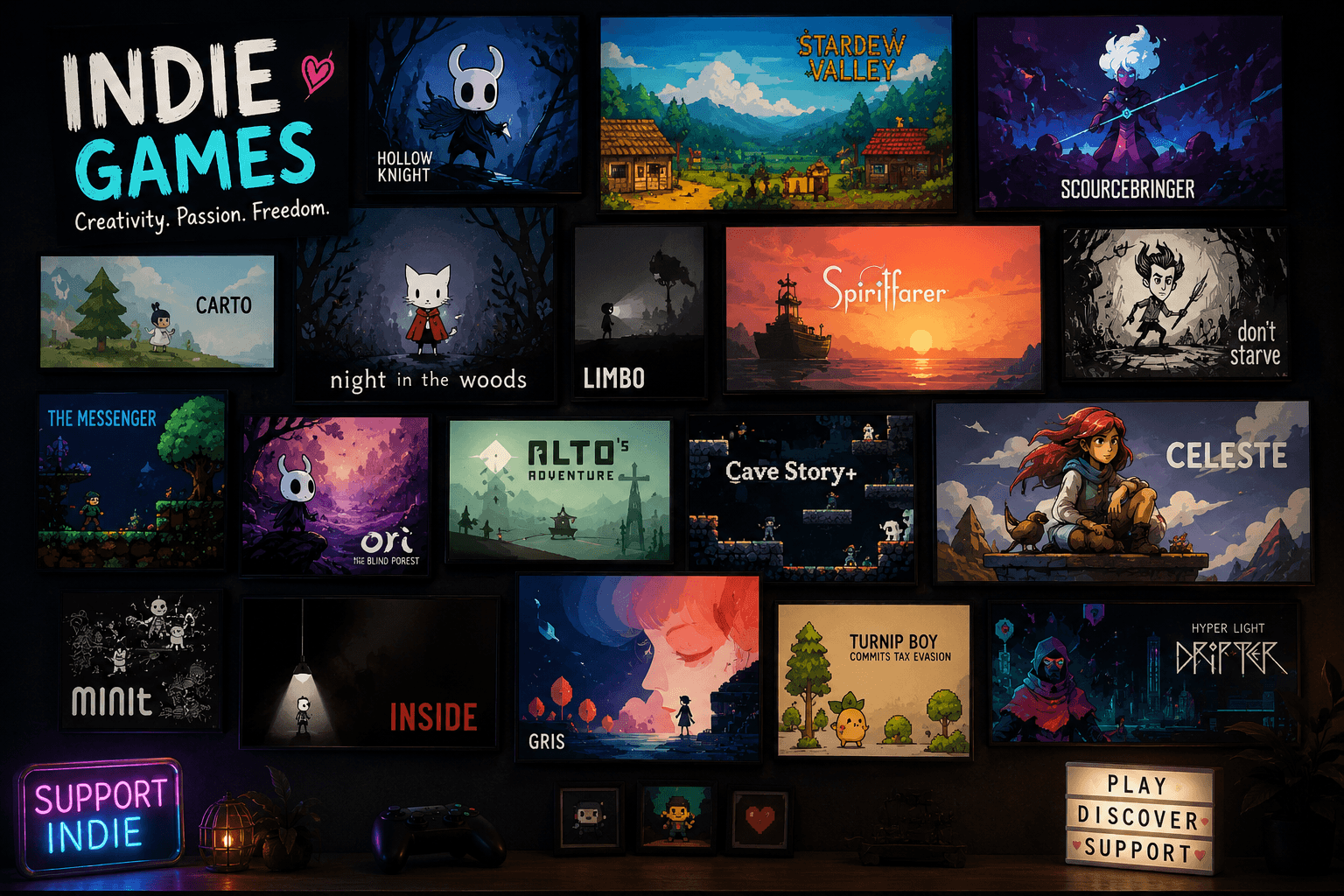
Meanwhile, Disco Elysium reimagined what an RPG could be. Celeste made a platformer into a metaphor for anxiety and recovery. Undertale used genre conventions as emotional tools. Hollow Knight built a world that rivaled games made with fifty times the budget.
None of those were AAA. All of them are better games, in certain ways, than most of what AAA produces.
Why Indie Games Have More Creative Freedom
A game with a $200 million budget needs to sell millions of copies to recoup that investment. This creates enormous pressure to appeal to the widest possible audience, which means avoiding anything divisive, unusual, or unfamiliar. The result is very good execution of familiar ideas.
A game made by a team of five with a budget of $300,000 needs to sell tens of thousands of copies. That's achievable with a niche audience. The financial math allows for niche, which allows for weird, which allows for innovation.
This is why the most mechanically experimental games, the most unusual narratives, and the most specific creative visions come disproportionately from small teams and solo developers. The risk profile lets them take risks.
Indie Games That Are Worth Your Time
Hollow Knight
A metroidvania set in a kingdom of bugs deep underground. The art is hand-drawn and distinctive. The movement and combat are precise. The world is large, interconnected, and full of secrets that reward genuine exploration rather than following a map marker. The atmosphere is melancholy in ways that feel earned rather than imposed. Made by Team Cherry, a team of two primary developers. Genuinely one of the best games made in the last decade.
Celeste
A precision platformer about climbing a mountain. The difficulty is substantial but fair — every death is explicable and fixable. The story addresses anxiety and mental health with more honesty than most games attempt. Assist Mode makes it accessible to players who can't handle the core difficulty. The music is excellent. The speedrunning community around it is one of the most positive in gaming.
Disco Elysium
A detective RPG where you play an amnesiac cop trying to solve a murder. The dialogue system is built around failed skill checks as much as successful ones — both give you information, just different information. The writing is extraordinary. The world has a coherent political and philosophical texture that most RPGs don't attempt. Not suitable for everyone (the themes are adult and the tone is dark), but for players who can engage with it, nothing else is quite like it.
Stardew Valley
One person, one game, four years of development, and an immediate hit that's still being updated. The farming RPG genre has existed for decades; ConcernedApe (the single developer) made a version of it that hit a larger audience than any of its predecessors. Relaxing, long, personal, and generous with content for a one-time price.
Undertale
A role-playing game where you don't have to kill anyone. The combat system gives you the option to talk to, spare, or flee from enemies. The game tracks your choices and responds to them in ways that feel genuinely surprising. The humor is sharp, the emotional moments land, and the meta-narrative elements are used thoughtfully rather than as gimmicks.
Hades
A roguelite where you play as the son of Hades escaping the underworld. You die, you start again, you learn new things, you go farther. The progression system rewards repeated attempts rather than punishing them. The narrative is embedded in the gameplay — every run advances the story a little, and you learn more about the characters through repeated conversations across many attempts. Supergiant Games made it; they're one of the most consistent studios in indie gaming.
Where to Find More
Itch.io has thousands of indie games, including many free ones from game jams. Steam's indie section is enormous and better filtered than it used to be. The Humble Bundle and similar services often have indie collections at low prices. If a game wins the Seumas McNally Grand Prize at the Independent Games Festival, it's worth looking at.
The mainstream gaming press covers major AAA releases by default. Finding good indie games requires more active seeking — following indie-focused outlets, checking game jam roundups, and paying attention to word-of-mouth in gaming communities. The games are there. The discovery just takes a little more effort.