The conversation around video games and whether they're good or bad for you tends to be dominated by extremes. One side treats gaming as categorically harmful — a waste of time at best, addiction-forming at worst. The other side dismisses all concerns as moral panic. Both are wrong in ways that matter.
Here's what the evidence actually shows, broken down by claim.
Cognitive Benefits: What Research Actually Shows
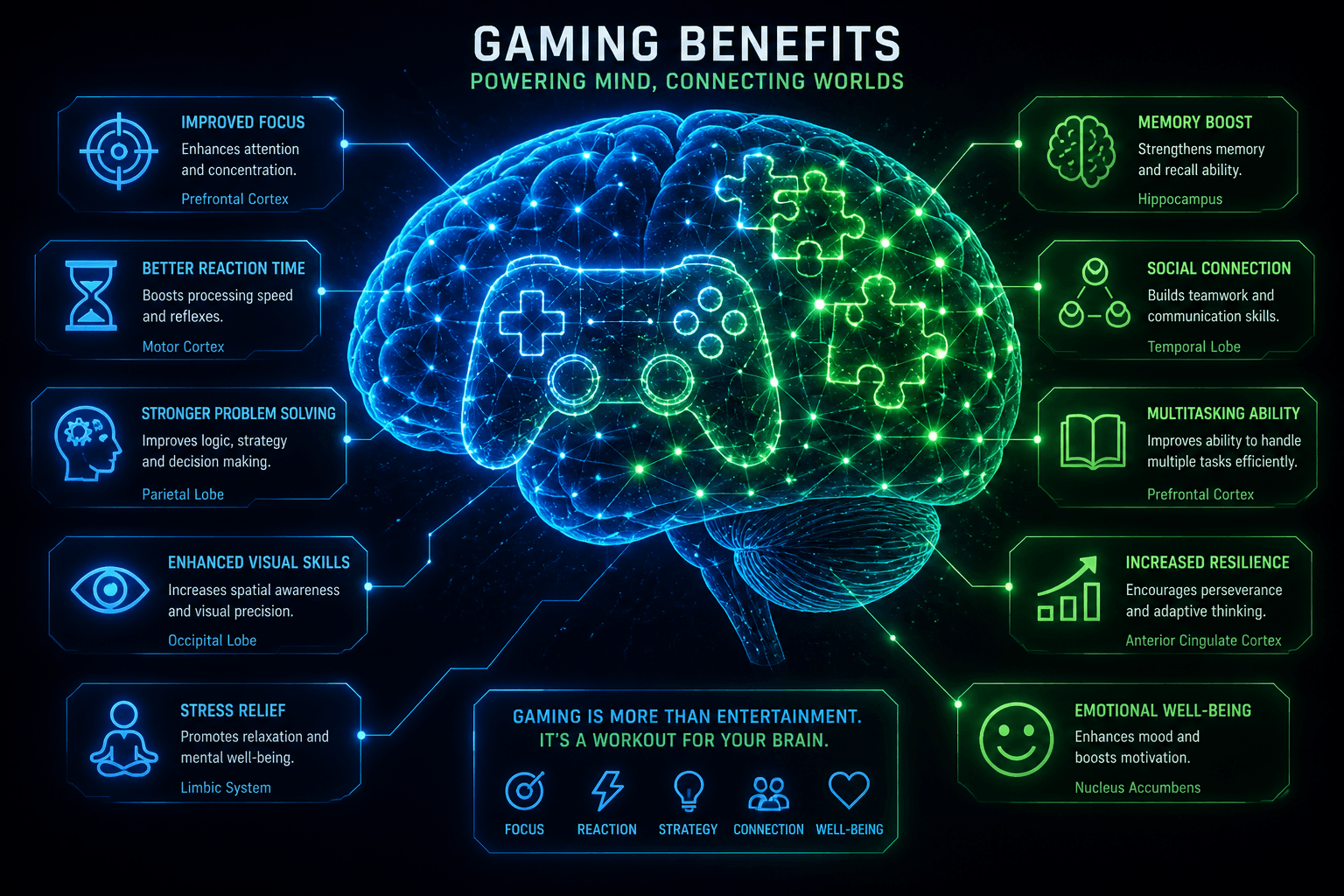
Action video games — fast-paced games that require quick responses and attention to multiple elements simultaneously — have been studied extensively. A meta-analysis published in Psychological Bulletin in 2014 reviewed 116 studies and found that players of action games showed improvements in attention, spatial cognition, perception, and cognitive flexibility compared to non-gamers.
Crucially, these improvements transferred to tasks outside the game. Players who trained on action games showed better performance on visual search tasks and attention tests that had nothing to do with gaming. This isn't what most skill training produces — usually you get better at the specific task, not related ones. The transfer suggests that fast-paced games are training underlying cognitive systems rather than just game-specific skills.
Puzzle games show improvements in logical reasoning and problem-solving. Strategy games show improvements in planning, resource management, and abstract thinking. The cognitive benefits are real; they're also specific to game type and don't apply universally to all games.
Social Benefits
The lone gamer in a dark basement is a stereotype that doesn't match how most people actually play. Pew Research Center data from recent years shows that a majority of American teens who play video games play with friends, either in-person or online. For many players, gaming is a primary social context — a place where friendships are maintained and deepened through shared experience.
Online multiplayer games require communication, coordination, and often the kind of role-based teamwork (tank, support, damage dealer) that requires understanding and responding to others. These aren't trivial social skills; they're the same ones valued in workplaces and collaborative projects.
For socially anxious individuals, gaming can provide a lower-pressure social environment. The shared activity reduces the awkwardness of conversation, provides natural topics to discuss, and allows relationships to form around something concrete rather than requiring pure social performance.
Emotional Regulation and Stress
Studies on gaming and stress show a nuanced picture. Gaming after a stressful event can reduce cortisol levels and negative mood — it functions as an effective way to decompress and disengage from stressors. This is real and valuable.
The complication is that gaming can also be used as avoidance — a way to not deal with problems that need dealing with. Whether gaming is healthy stress relief or problematic avoidance depends on what else the person is doing or not doing. Gaming that complements a functional life is stress relief. Gaming that replaces necessary activities (sleep, work, relationships, physical health) is a different situation.
The Problematic Use Question
Gaming disorder — a pattern of gaming behavior characterized by loss of control, increasing priority of gaming over other activities, and continuation despite negative consequences — is recognized by the WHO. It's also estimated to affect somewhere between 1-3% of gamers, depending on the study and criteria used.
The vast majority of people who game heavily don't meet criteria for disorder. Time spent gaming doesn't determine whether it's problematic; what matters is whether gaming is interfering with other important areas of life. Someone who games 30 hours a week while maintaining work, relationships, and health is in a different situation from someone who games 15 hours a week while neglecting all three.
The Actual Takeaway
Gaming, for most people who play, is a hobby with genuine benefits and manageable costs. It provides cognitive challenge, social connection, emotional engagement, and entertainment. Like any activity — exercise, social media, television — the impact depends on how it fits into the rest of a person's life rather than on the activity itself.
The research doesn't support treating gaming as inherently harmful, and it doesn't support treating it as inherently beneficial. It supports treating it as a human activity with real effects that depends on context. That's a less satisfying conclusion than either extreme, but it's the accurate one.