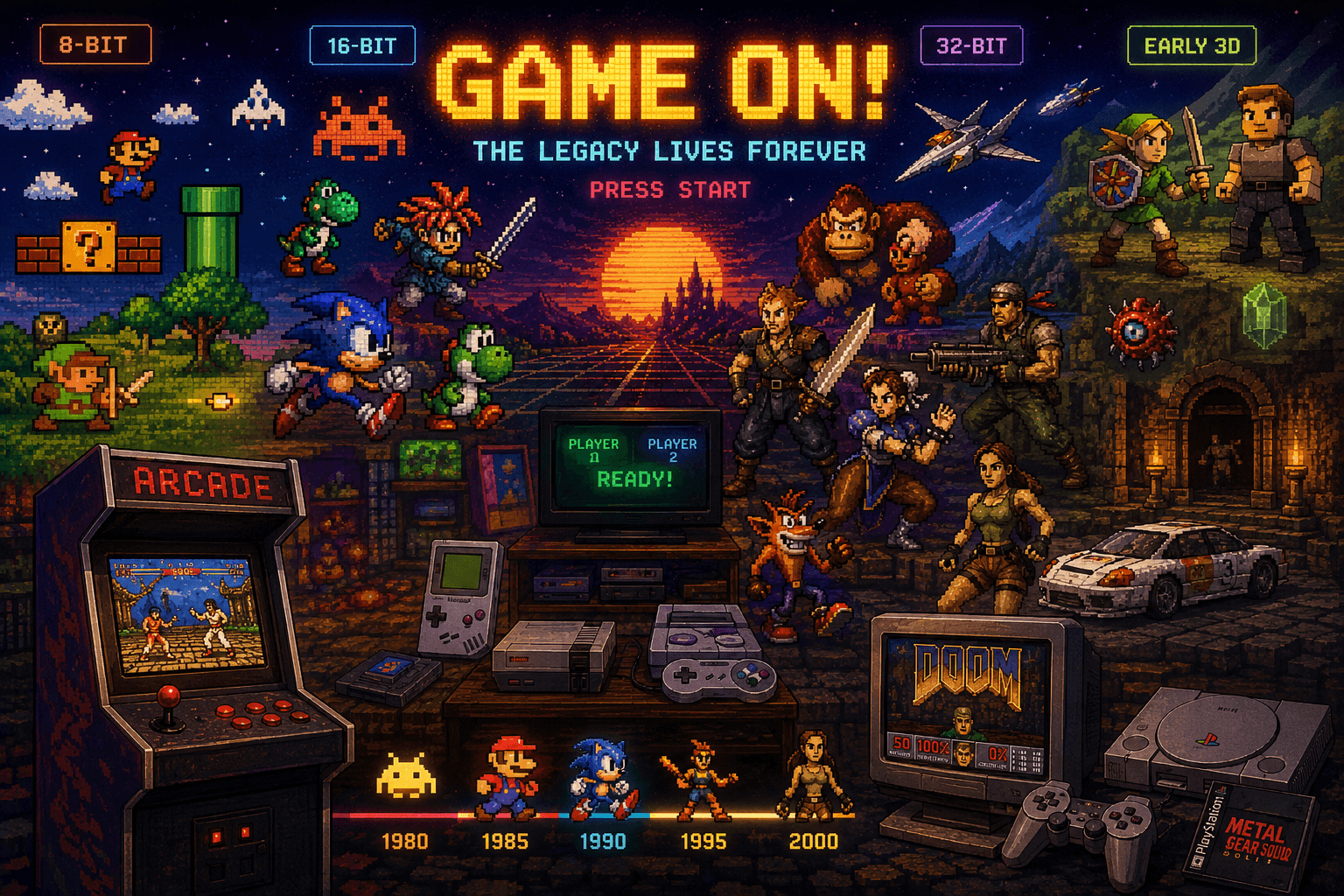
Nostalgia makes everything seem better than it was. But some games hold up without nostalgia — they're actually good by modern standards, not just remembered fondly. These eight games shaped a generation of players and remain worth playing today, not as historical artifacts but as genuinely good games.
1. The Legend of Zelda: Ocarina of Time (1998)
The first 3D Zelda and still a remarkable achievement in game design. The world feels alive in a way that many later open worlds don't. The dungeon design — each one built around a single mechanic that gets thoroughly explored across its puzzles — is still a template that developers cite. Z-targeting solved 3D combat in a way that felt intuitive rather than like a workaround. Twenty-five years old and still taught in game design courses.
2. Half-Life 2 (2004)
Environmental storytelling that influenced an entire decade of first-person games. Half-Life 2 tells its story almost entirely through the world around you rather than cutscenes — the resistance graffiti, the controlled environments, the behavior of citizens — and it's more effective for it. The physics-based gameplay that was revolutionary in 2004 feels natural rather than dated because the design used it for puzzles rather than tech demos. Still playable, still effective.
3. Super Mario 64 (1996)
The game that defined 3D platformers. The movement system — how Mario runs, jumps, long-jumps, backflips, and dives — still feels good to control because it was designed to feel expressive rather than just functional. Collecting stars never gets old because the movement makes getting to them fun in itself. The camera hasn't aged well, but the core game has.
4. StarCraft (1998)
Real-time strategy at its most refined. Three asymmetric races with completely different unit compositions, tech trees, and playstyles that all remain viable at the highest level of competition. The game's competitive balance — achieved largely through iteration and playtesting rather than mathematical calculation — is still studied. The remastered version makes it look modern while preserving the mechanics that made it great.
5. Metal Gear Solid (1998)
Cinematic storytelling in games, done well, in 1998. The codec conversations are dense with lore and surprisingly funny. The bosses are memorable because they have personalities and stories, not just attack patterns. The fourth-wall-breaking moments feel earned. The gameplay has dated more than the narrative design, but the narrative design is why it's on this list.
6. Diablo II (2000)
The action RPG that defined the genre and still defines it. The loot system — item randomization that produces theoretically infinite variation in equipment — is still the template for ARPGs. Sessions naturally extend past their intended length because "just one more dungeon" produces another item worth evaluating. Diablo II Resurrected brought it to modern hardware with updated visuals while leaving the mechanics intact, because the mechanics didn't need changing.
7. GoldenEye 007 (1997)
The game that proved console shooters were viable and that split-screen multiplayer was a social event. The single-player campaign had legitimate stealth and mission structure that most shooters of the era didn't attempt. The multiplayer — four players, one screen, choosing who could use Oddjob — created arguments that generations of siblings haven't resolved. It's aged more than most games on this list, but its cultural impact was enormous and specific.
8. Portal 2 (2011)
Technically not old enough to be "classic" by some definitions, but it's already been fifteen years and the game shows no signs of aging. The puzzle design is flawless — each mechanic is introduced, developed, and combined with other mechanics in a sequence that teaches through play rather than tutorials. The writing is some of the best in any game. GLaDOS is still the best antagonist in gaming.
What They Share
None of these games were the most technically impressive of their era. What they share is design clarity — they knew what they were trying to do and did it without compromise. That kind of clear design intent ages better than technical achievement because the technology changes; the design principles don't.