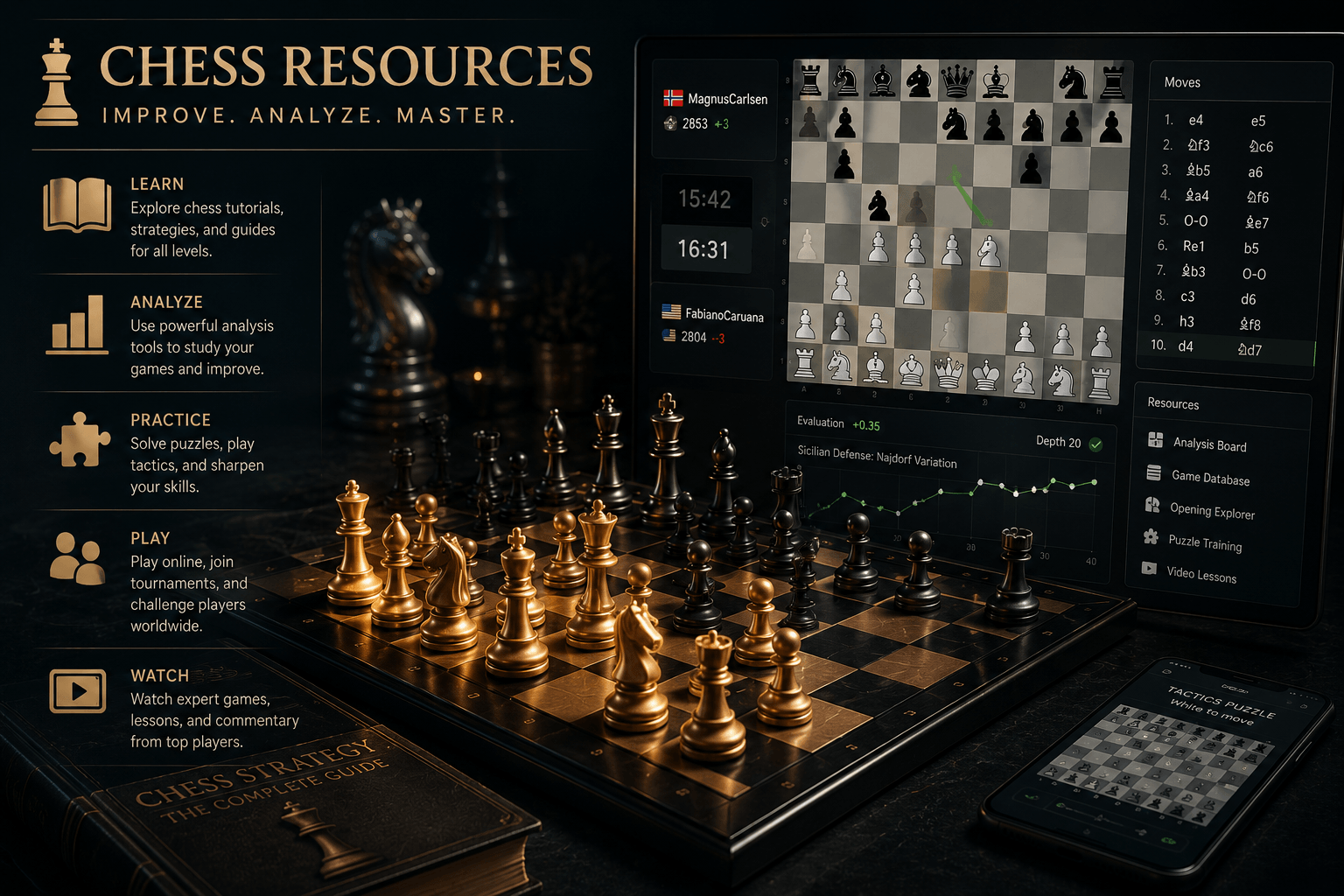
Chess is unusual among competitive games because improvement resources are abundant and mostly free. You don't need coaching, expensive courses, or premium subscriptions to get from complete beginner to solid intermediate player. You need the right sequence of free tools and some consistent time.
This is the path that works.
Step 1: Learn the Rules Completely
Chess has rules that most beginners don't fully learn. They know how pieces move but miss some specific rules that matter in actual play.
En passant is a special pawn capture that beginners don't learn until they're surprised by it in a game. Castling has specific conditions — neither the king nor the chosen rook can have moved, the king cannot be in check, and the squares between them must be empty and unattacked. Promotion: a pawn that reaches the last rank promotes to any piece, not just the piece that was captured. Stalemate: if it's your turn and you have no legal moves and you're not in check, the game is a draw.
Chess.com's "Learn" section covers all of these with interactive examples. Go through it completely before moving on. Missing a rule in a real game is frustrating and avoidable.
Step 2: Learn Basic Checkmates
Knowing how to win when you have a material advantage is a separate skill from knowing chess tactics. Many beginners win material and then stall because they don't know how to force checkmate.
Learn these in order: King and Queen vs. King. King and Rook vs. King. These are the most common ending scenarios. King and Two Bishops vs. King and King and Bishop and Knight vs. King are more complex and can wait.
Chess.com and Lichess both have practice modes for these specific endings. Run through them until you can execute them reliably in under fifty moves.
Step 3: Lichess — Completely Free, No Compromises
Lichess is an open-source chess platform that is genuinely free — no premium tier, no locked features. Everything on the site is available to every user.
The puzzle section gives you thousands of tactical puzzles to solve. Puzzles are the most efficient way to improve at chess — they train you to see patterns quickly, and pattern recognition is most of what separates intermediate from beginner players. Do fifteen to thirty puzzles per day consistently.
The analysis tool shows you the engine evaluation of your games. After each game, go through it and look at the moments where the evaluation changed significantly. These are your mistakes. Over time, the same types of mistakes will appear — that tells you what to study.
Step 4: Chess.com's Free Tier
Chess.com has a premium tier that costs money. The free tier is still useful. You get daily puzzles, games with computer opponents at different difficulty levels, and basic game analysis.
The "Play Computer" feature lets you practice against AI at adjustable difficulty without the pressure of playing another person. This is good for testing things — openings, endgame techniques, tactics — without the time pressure of a live game.
Step 5: Learn One Opening Well
Beginners often spend too much time on opening theory. At the beginner level, how you play the middle game matters far more than which opening you use. But having one basic opening you understand — rather than making random moves every game — is helpful.
For white, the Italian Game and the London System are both learnable and solid without being complicated. For black, the Caro-Kann against 1.e4 and the King's Indian against 1.d4 are popular for a reason — they're robust and don't require memorizing long forcing lines.
The key is to understand why each move in your opening is made, not just memorize the sequence. YouTube channels like GothamChess (Levy Rozman) and ChessNetwork cover beginner openings clearly and for free.
Step 6: Play Games With Time Control
Blitz games (3-5 minutes per player) are popular but bad for learning. You make fast decisions based on instinct, which reinforces bad habits.
Play rapid games — 10-15 minutes per player. This gives you enough time to actually think about your moves, consider threats and opportunities, and play in a way that's close to how you've studied. Analyzing a rapid game is more useful than analyzing a blitz game because you had time to actually make real decisions.
How Long Does It Actually Take?
Getting from complete beginner to 800 rating on Chess.com (the common baseline for "I know how to play") usually takes two to four months of consistent play and study. Getting to 1200 (solid intermediate) typically takes one to two years of consistent engagement.
Chess improvement is slow. Players who stick with it past the frustration period — the phase where you understand enough to see your mistakes but not enough to stop making them — consistently report that it clicks at some point and improvement accelerates. The plateau before that click is where most players quit.
The resources exist to get there. They're free. The only variable is whether you use them consistently.