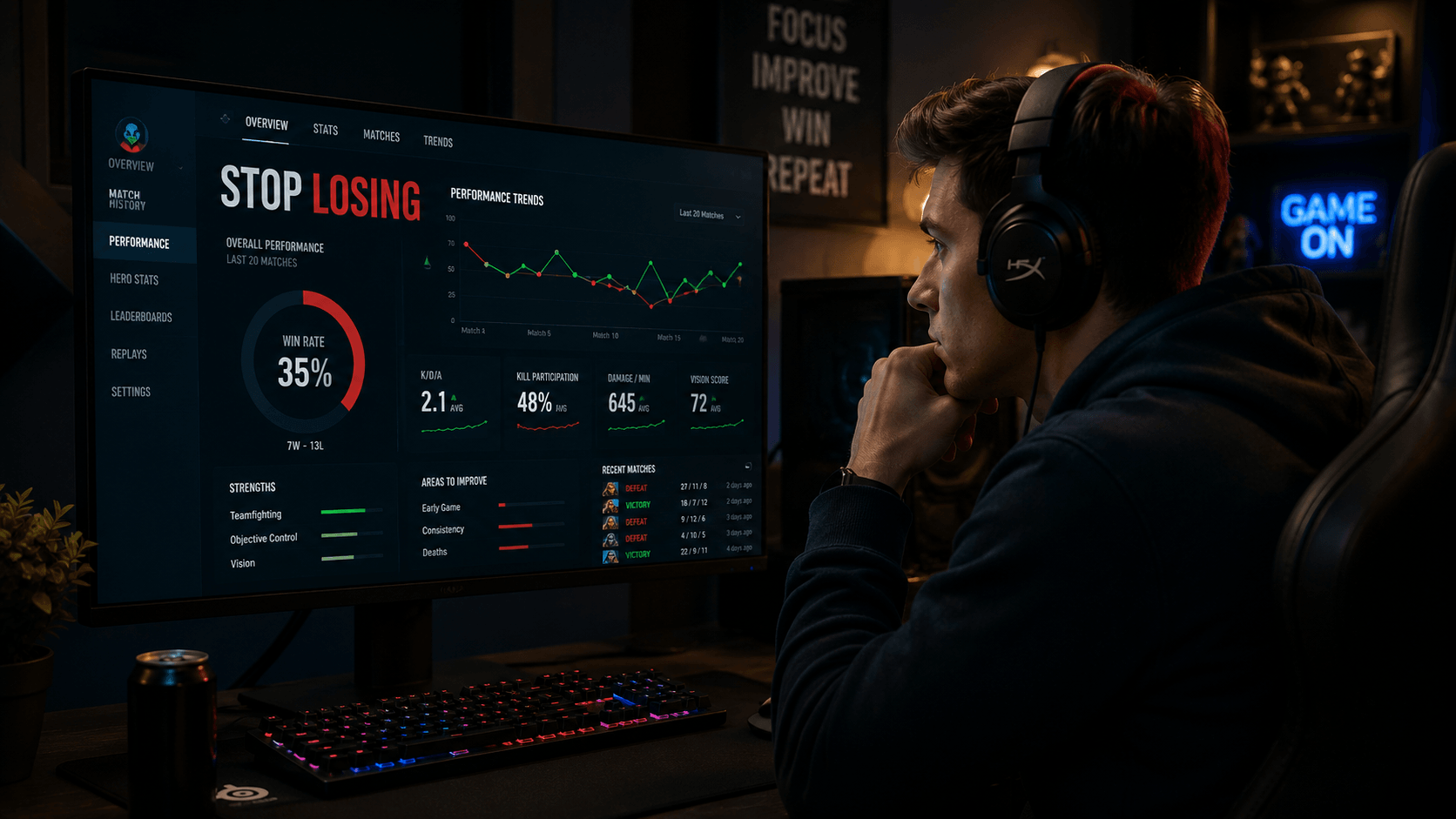
There's a specific frustration that comes from losing in online games repeatedly while feeling like you're trying. You're not clearly making obvious mistakes. You're not new to the game. You just keep losing, and you're not sure why.
Most persistent losing streaks have identifiable causes that aren't immediately obvious. Here are the seven most common ones.
1. You're Not Adapting to the Match
Strategy that works in general doesn't always work in a specific match against a specific set of players. If your approach isn't working and you keep doing it anyway, the match will keep going the same way.
Adapting mid-match is a skill. It requires noticing that something isn't working, diagnosing why, and adjusting. Most players do the diagnosis (I keep dying in the same place / my opponent keeps beating me with the same move) but skip the adjustment (so let me change what I'm doing). The instinct is to try to execute the same plan better rather than try a different plan.
When something isn't working: change something. Position, timing, weapon choice, route, approach — any meaningful variable. Wrong adjustments are information. Right ones are wins.
2. You're Playing Out of Position
In most competitive games, position is the largest single determinant of outcomes. The player in a stronger position has more options, more time to react, and lower risk. Bad position forces good players to make impossible decisions.
What counts as good position varies by game: high ground in shooters, center control in strategy games, river control in MOBAs, corner control in fighting games. Whatever the genre, there are positions that advantage you and positions that disadvantage you. Prioritizing good position consistently — even over individual fights you might win — changes win rates significantly.
3. You're Taking Bad Fights
Every fight in a competitive game has a probability distribution — some are 80/20 in your favor, some are 50/50, some are 20/80. Good players take mostly favorable fights and avoid unfavorable ones. Bad players take whatever fight is in front of them.
Signs of a bad fight: you're outnumbered, you're on low health, you're in a disadvantaged position, you're using a less effective tool than your opponent, you have no escape route. Any one of these can be manageable; multiple at once is a fight you should probably avoid.
Letting fights go feels wrong — the instinct is to engage. But the expected outcome of a 20/80 fight is a loss, and taking many 20/80 fights adds up to a losing record regardless of how well you play each individual fight.
4. You're Not Using Resources at the Right Time
Every game has resources — health items, abilities, special moves, economy, whatever form the game uses. Hoarding them and losing is more common than you'd think. Players save their best abilities for a perfect moment that never comes while dying with resources unused.
Resources exist to use. Using them at 60% of optimal timing is almost always better than not using them at all. The exception is situations where you genuinely know a harder challenge is coming and need to be prepared — but even then, many players hold resources longer than justified.
5. You're Tilting and Not Stopping
Tilt is a poker term for playing badly due to emotional state after a bad beat. In gaming, it means continuing to play after a loss while frustrated, which leads to more losses, more frustration, and a spiral.
Tilted play looks like: taking more risks than usual, abandoning strategy for aggression, blaming teammates loudly, and making decisions you'd recognize as bad when calm. The output is predictably worse than your normal play.
The fix is stopping. It's not playing one more game to end on a win — that's usually how you end up playing five more games and ending on a loss at 1am. Stop, do something else, come back when you're not angry about gaming.
6. You're Not Watching Your Positioning Relative to Your Team
In team games, where you are relative to your teammates matters as much as where you are on the map. Being out of position from your team means they can't help you and you can't help them. Enemies can pick you off one at a time rather than facing your full team.
Players focused on individual play sometimes ignore team positioning — they see an opportunity and take it without checking whether they're alone. Good positioning in a team game often means deliberately being in a slightly less good individual position but a much better team position.
7. You're Not Identifying What You're Actually Good At
Every player has relative strengths and weaknesses. Playing in a style that doesn't match your strengths consistently leads to underperformance regardless of your overall skill level.
Some players are better at reactive play than proactive play. Some are better at controlling space than at mechanical execution. Some are better at long engagements than short ones. Knowing what you do well and building your strategy around it — rather than trying to play in a style that doesn't suit you — is one of the highest-leverage adjustments a persistent loser can make.
This requires some self-knowledge that's uncomfortable to develop. But if you've been playing the same way for months with the same results, the question worth asking is: what am I actually good at, and am I playing in a way that uses it?
The Pattern
Most persistent losing isn't about reflexes, aim, or raw mechanical skill. It's about decision-making patterns that can be identified and changed. Identify what's actually happening in your losses, change one thing at a time, and track whether the change helps. That's how you actually stop the streak rather than waiting for luck to change it.