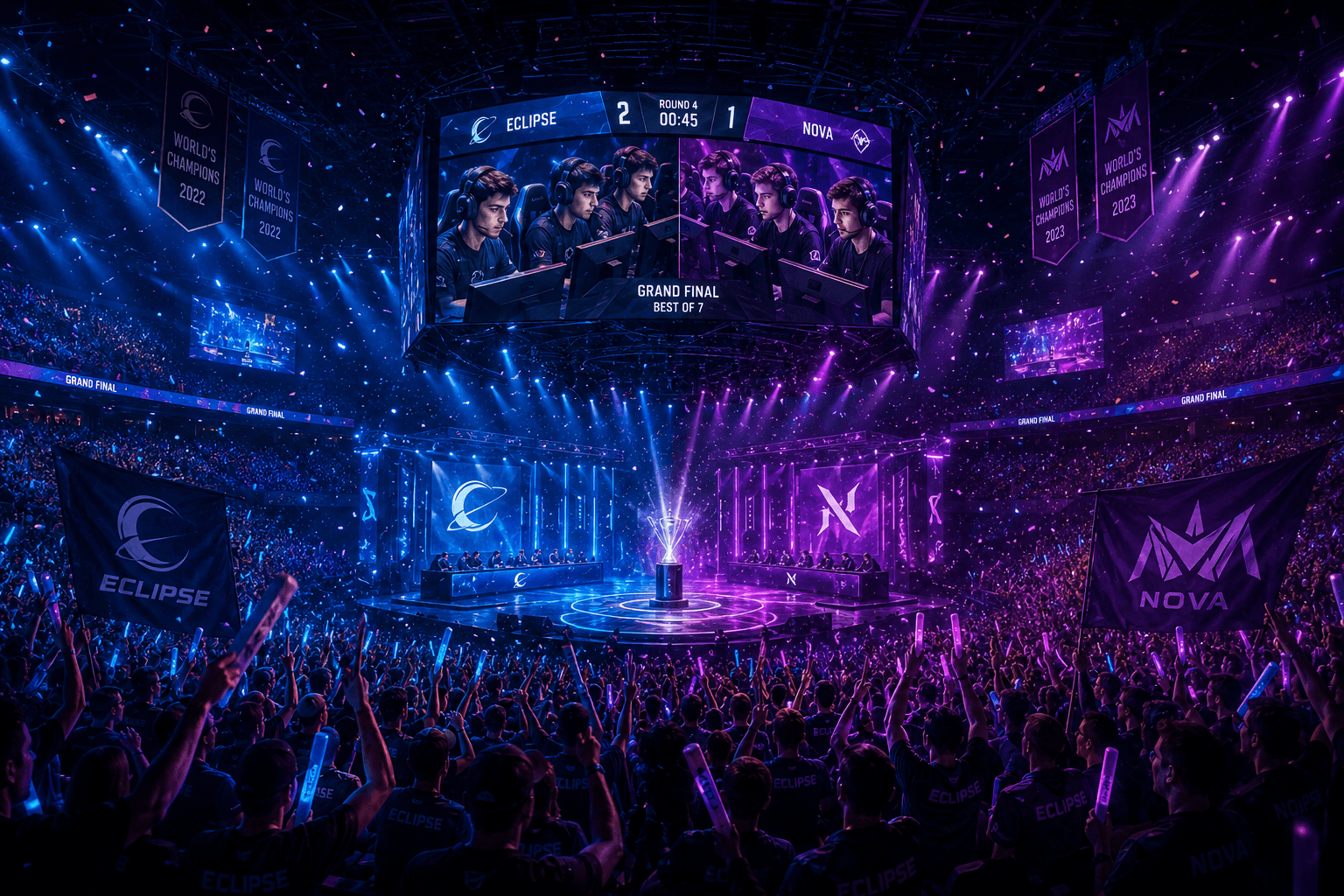
Esports is now a global industry worth billions of dollars with professional leagues, sold-out arenas, and prize pools that rival traditional sports. The speed of that growth is remarkable. Twenty-five years ago, competitive gaming was primarily a hobbyist activity organized on forums and played in LAN cafes. Here's the sequence of events that changed that.
The Early Days: Korea and Starcraft (1998–2005)
The modern esports industry has clear roots in South Korea. During the late 1990s, South Korea invested heavily in broadband infrastructure, resulting in widespread high-speed internet access well ahead of most other countries. Alongside this, PC bangs — internet cafes where people paid by the hour to use computers — became a dominant social institution.
Blizzard's Starcraft, released in 1998, became the game of choice in PC bangs. The real-time strategy game required significant skill and rewarded practice. By 2000, Korean cable channels were broadcasting professional Starcraft matches, and professional players had sponsorships, salaries, and fan followings comparable to traditional athletes. This was the first time competitive gaming looked structurally like a real sport.
The Korean Starcraft scene remained largely a Korean phenomenon for years. The rest of the world watched from the outside, impressed but not fully replicating the model.
The Western Scene: CS and Quake (2000–2010)
In North America and Europe, competitive gaming developed around different games. Counter-Strike became the dominant team game; Quake produced individual skill competitions. Events like the Cyberathlete Professional League (CPL) ran large tournaments with meaningful prize pools. The Electronic Sports World Cup began in 2003.
These events were real but modest. Prize pools were in the tens of thousands rather than millions. Venues were convention halls rather than arenas. Audiences were almost entirely people already invested in gaming. The broader public wasn't paying attention yet.
Streaming Changes Everything (2011–2015)
Twitch launched in 2011 as a dedicated game streaming platform. Previously, watching someone else play a game required being in the same room or finding archived VODs. Twitch made it possible to watch live gameplay from anywhere, on demand, for free, with chat that made the experience social.
The timing aligned with the explosion of League of Legends, which became the most played PC game in the world within a few years of launch. Riot Games invested heavily in competitive infrastructure — the League Championship Series launched in 2013 as a fully produced weekly broadcast with salaried players, coaches, and production values approaching traditional sports broadcasts.
Dota 2's "The International" in 2013 had a crowd-funded prize pool that broke $2 million. The following year it broke $10 million. The year after that, $18 million. The numbers made headlines outside gaming communities for the first time.
The Investment Wave (2016–2019)
Large prize pools attracted attention from traditional sports owners, venture capital firms, and media companies. The NBA's esports league launched in 2018. Major sports team owners bought franchises in Overwatch League and Call of Duty League. Traditional sports media companies signed broadcasting deals.
The franchise model — permanent team slots in city-based leagues, similar to traditional sports — was an attempt to create stable investment vehicles. The economics proved harder than anticipated, but the structural transition from grassroots tournaments to corporate-backed franchises was complete.
Where Things Stand Now
The esports industry has gone through a significant correction since the peak optimism of 2018-2019. Several franchised leagues have contracted. Investment has slowed as projected revenues proved optimistic. But the underlying foundation remains: millions of people watch competitive gaming, professional players earn significant salaries in top titles, and major tournaments fill arenas.
The industry looks more like the mature gaming market than like traditional sports — fragmented, game-dependent, with peaks in specific titles rather than a rising tide for all competitive games. Titles like League of Legends, CS2, Dota 2, and Valorant have stable competitive scenes. Many others have come and gone.
The story of esports is one of genuine emergence — something new finding its shape through trial, investment, and adjustment. It's not finished yet, which makes it worth watching.