Most people know classic 2048. You slide numbered tiles around a 4x4 grid, two of the same number merge, and you keep going until the board jams. It's simple, and that's why it's so easy to waste twenty minutes on it.
2048 Advanced on AxoGamer changes a few things, and those changes matter more than they look. This guide covers what's different, what actually works, and the mistakes I keep seeing (and making).
What's different in 2048 Advanced
When you open the game, the How to Play box gives you four rules:
- Swipe, or use the arrow keys, to move tiles.
- Merge identical numbers to level up.
- Reach the target score to move on.
- Rocks cannot move or merge.
That last line is the big one. More on rocks in a minute.
The other change is the level system. You don't just play until you lose. Level 1 shows TARGET: 256 at the top, next to your score and your best. Hit the target and you get a "Level Passed" screen with stars, then a "Continue" button for the next challenge. So it feels less like one endless grind and more like a set of short puzzles.
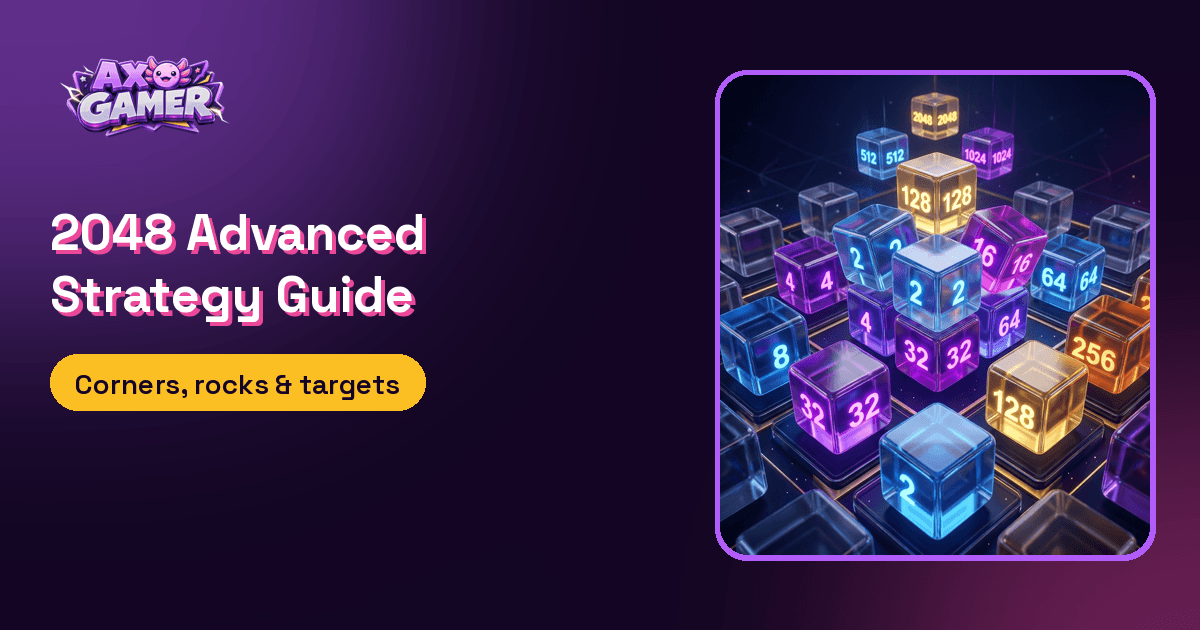
The tiles also look nicer than the old flat squares. They're glowing glass blocks in purple, blue, green and orange, and the bigger numbers stand out on the dark background. That sounds minor, but it makes the board easier to read when you're moving fast.
The corner strategy still works
If you've played normal 2048, you already know this. If not, it's the one habit that will improve your game the most.
Pick one corner, say bottom-left, and decide your biggest tile lives there. Forever. Then mostly use only two or three directions. For bottom-left, that's down and left, with right when you have to. Avoid up unless the board forces you.
Why it works: your big tile stays put, and smaller tiles line up next to it in a rough chain (128, 64, 32...). When they merge, they roll toward the big one instead of getting stuck in the middle.
When you press up and your big tile moves out of the corner, a small 2 usually drops into that corner straight away. Now your best tile is stranded. It's the most common way a good run falls apart.
How to handle rocks
Rocks are fixed blocks that don't slide and don't merge. In practice they shrink the board and break up your lanes.
A few things help:
Don't fight them. You can't move a rock, so build around it. If a rock sits on the edge you wanted for your chain, switch to another corner early instead of hoping it goes away.
Treat a rock like a wall. Tiles slide up against a rock the same way they hit the board edge. Sometimes that's useful. A rock in the middle row can hold a tile in place while you line up a merge beside it.
Keep more empty space than usual. With fewer usable cells, the board fills up faster than in classic 2048. If you're down to two or three empty cells, stop going for big merges and just clear small pairs.
Hitting the target score
The target is a score, not a tile. In 2048 games your score goes up every time two tiles merge (by the value of the new tile). So you're not racing to make one giant tile. Steady merging counts too.
That changes how you should play the early levels:
1. Merge often. Lots of small 4s and 8s add up quickly. You don't need a perfect chain to reach 256 points.
2. Don't take risks near the target. When you're close, play safe moves. A sudden game over at 240 out of 256 hurts more than taking ten extra careful moves.
3. Use pause. There's a pause button at the top with Resume and Restart Level. If you need a break, pause instead of leaving the tab mid-game.
Common mistakes
Moving at random when you're stuck. Everyone does it. It's sometimes fine in the first few seconds, but later random swipes ruin your chain. Slow down when the board gets tight.
Ignoring the second row. People protect the corner and forget the row next to it. Keep that row filled with tiles in roughly descending order so merges cascade.
Chasing a merge on the wrong side. If two 32s are far apart and joining them means pulling your big tile out of its corner, leave them. Another pair will come.
Playing angry. "No moves left!" shows up, you hit Try Again within half a second, and you make the same mistakes. Take five seconds to look at what blocked you. Usually it was one bad direction.
Keyboard vs phone
The game supports arrow keys and swipes. On a laptop, arrows are faster and more precise. You'll rarely send a tile the wrong way. On a phone, swipes feel natural, but quick diagonal-ish swipes sometimes register in a direction you didn't mean. Use short, clear swipes, and don't rush on mobile.
Why I keep coming back to it
The level targets are the reason. Classic 2048 can feel like one long session you never finish. Here you clear a level, see your stars, and the next target gives you a small, clear goal. It fits nicely into a five-minute break. And the rocks give you a new problem every so often instead of the exact same board every time.
Quick checklist before you start
- Choose your corner before the first move.
- Use two directions most of the time, a third only when needed.
- Never press the direction that pulls your big tile out (unless forced).
- Plan around rocks early. Don't wait for them to become a problem.
- Near the target, play safe.
That's really it. 2048 Advanced isn't about luck as much as it looks. A bit of discipline gets you much further than fast fingers.
Play it free in your browser: 2048 Advanced on AxoGamer. No download, works on phone and laptop.